This blog explores the key differences between Public Policy and Public Administration, highlights the career opportunities, required skills, and how each field contributes to governance, policymaking, and public sector leadership.
You have two tabs open on your browser.
Master’s in Public Policy (MPP). The other says Master’s in Public Administration (MPA)
Like any curious student, you start comparing the courses.
Governance? Both have it.
Economics? Check.
Research methods? Yep, both.
Public finance, policy analysis again, the same.
You pause and lean back. “Seriously… are these just the same degree with different names?”
One college offers a Master’s in Public Policy course. The college right next door offers a Master’s in Public Administration degree.
As you scroll through the curriculum, the similarities keep piling up. On paper, they look almost identical.
So, where does the difference really lie?
This question has been part of the discourse for years.
While public policy and public administration overlap, they are far from identical.
Understanding the difference between MPP vs MPA is crucial as it shapes the career path you choose, the public policy skills you develop, and the type of impact you make in public policy careers and public administration careers.
Let’s break down what actually separates them.
Public Policy vs. Public Administration: The Core Difference
Think of it this way:
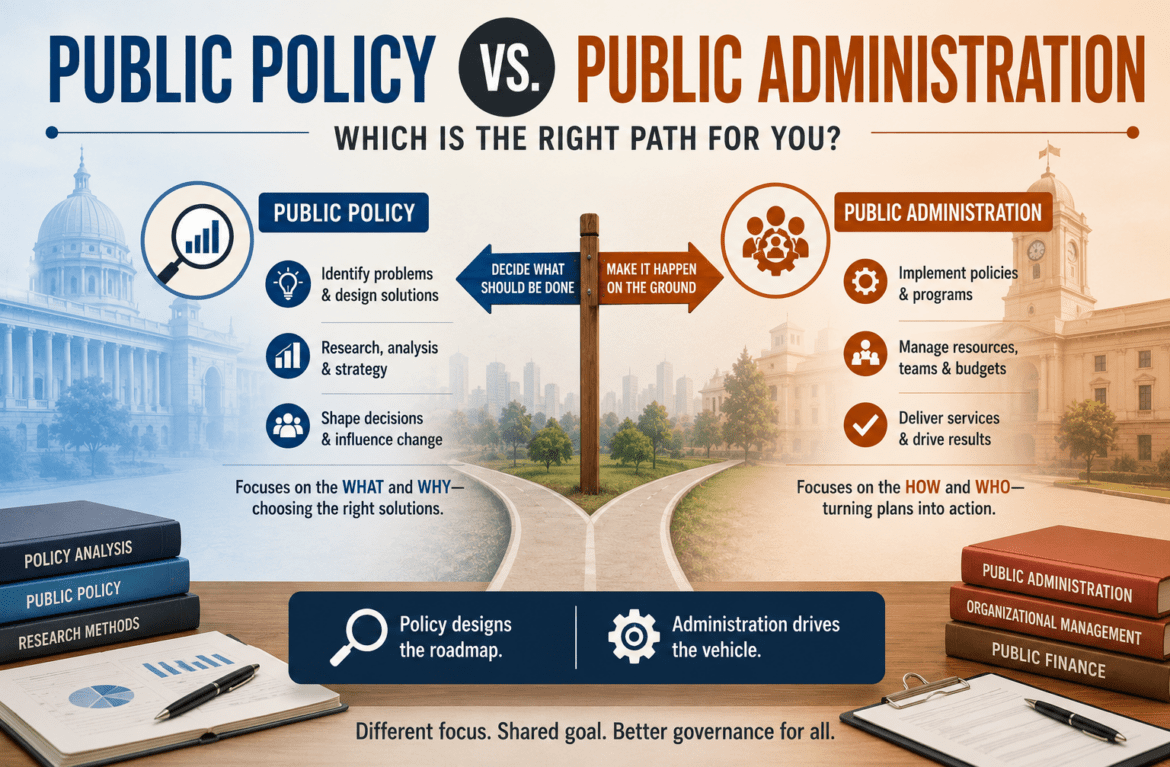
Public Policy is about deciding what needs to be done and forms the foundation of many public policy careers.
It’s the process of identifying societal problems and figuring out the best solutions. How can air pollution be reduced? What’s the most effective way to create jobs?
Policy professionals research these questions, analyze data, study examples from elsewhere, and recommend the best course of action. They are problem-solvers who say: Here’s what we should do, and why.
Public Administration, in contrast, is primarily about making it happen and is central to many public administration careers.
Once decisions are made, administrators implement them on the ground. They manage people, budgets, and systems, coordinating departments and solving countless day-to-day challenges to deliver services to millions.
Key Distinction
Policy focuses on the ‘what’ and ‘why’, what problem are we solving, and why is this the best solution.
Administration focuses on the ‘how’ and ‘who’, how will this be implemented, and who ensures it works?
|
Aspect |
Public Policy |
Public Administration |
|
Primary Focus |
– Study and analyze social, economic, and political issues – Design and create policies – Evaluate policy outcomes before implementation |
– Implement policies and programs – Ensure programs and regulations are executed effectively |
|
Core Skills |
– Research and data analysis |
– Planning, organizing, and supervising |
|
Key Activities |
– Identify social problems and set objectives |
– Implement laws and service programs |
|
Typical Roles |
– Policy Analyst |
– District Administrator |
|
Ideal for Students Who? |
– Enjoy research, analysis, and strategy |
– Enjoy seeing results in action |
How Policy and Administration Work Together in the Real World
Yes, the distinction is important, but what matters even more is how closely public policy and public administration are connected. Here’s what makes it even more interesting: public policy and public administration do not work in isolation; they are two sides of the same coin. In fact, the most successful government initiatives happen when both work in harmony.
The policy side identifies the problem, researches solutions, analyzes costs and benefits, and designs the strategic framework. They answer the big questions: What are we trying to achieve? Why is this the best approach?
But policy alone changes nothing on the ground.
That’s where administration steps in. Administrators coordinate resources, manage budgets, oversee implementation teams, handle logistics, and troubleshoot daily challenges. When plans meet reality, delayed deliveries, staff shortages, community resistance, budget constraints, administrators find solutions. They translate the blueprint into actual outcomes that people can see and experience.
Policy designs the roadmap; administration drives the vehicle. One without the other is incomplete.
Careers in Public Policy
- Policy Analyst: Think tanks like NITI Aayog or Centre for Policy Research hire analysts to research issues and draft recommendations.
- Research Associate: Support senior analysts with data collection and literature reviews, an ideal entry point a career in public policy.
- Policy Consultant: Firms like McKinsey or PwC advise governments on reforms and program design.
- NGOs & International Organizations: World Bank, UNDP, or WHO design interventions that rely on policy expertise & offer diverse public policy jobs.
Careers in Public Administration
- Civil Services: IAS, IPS, and IRS officers manage districts, departments, and critical governance functions.
- Program Managers at NGOs: Lead education and development initiatives on the ground, e.g., Pratham or Teach For India.
- Field Managers at International Agencies: Execute programs in challenging environments and build impactful public administration careers.
- International Development Professionals: Work with organizations to implement large-scale development programs, manage partnerships, and deliver public services effectively
Decide What Fits You
– Love research, analysis, and strategy? → Public Policy
– Enjoy execution, managing programs, and seeing results firsthand? → Public Administration
Understanding the difference between a Master’s in Public Policy and a Master’s in Public Administration helps you choose not just a degree, but a career path that matches your interests and long-term goals.
Curious which path suits you?
Join India House’s Policy Pioneers program to explore careers in public policy and administration, develop practical public policy skills, and gain mentorship through a hands-on public policy leadership program and a community of like-minded changemakers.
The Policy Pioneers program at India House offers exactly this kind of exposure and training. It’s a four-month, hands-on experience where you can work on real projects, engage with mentors, and get a feel for public policy careers and public administration careers on the ground. It’s learning by doing, not just by reading textbooks.
Coming back to the original question: which tab to choose: Master’s in Public Policy or a Master’s in Public Administration: We say: neither.
You see, India’s public policy space is still evolving and most of the current master’s curriculum and design is archaic. You would probably need much more practical exposure. So, our recommendation to you would be to explore possible practical exposures: be it a role in a think tank or a ministry, or explore short-duration part-time public policy courses in India that can help you explore your interests further.
Tagscareers, Masters in Public Administration, Masters in Public Policy, public administration, public policy
CategoriesBlog
DateJun 23, 2026