
Ask ten people why they want to work in public policy, and most will say: impact, governance, change.
Ask what public policy careers actually looks like, and you’ll get ten different answers, most of them vague.
It’s a living ecosystem of roles, researchers, implementers, analysts, advocates, each shaping how decisions reach the people they serve.
If you’re curious about public policy roles but aren’t sure what public policy career paths exist, or if you’re already in the field and want to explore other roles, you’re in the right place.
Finding Your Fit:
Before you step into a public policy career, you need clarity. Understanding your interests, the problems that motivate you, and the kind of impact you want to create helps you navigate this complex field.
Before moving ahead, pause for a moment and ask yourself these questions.
Q1) Who are you?
Understanding yourself is the first step in choosing a public policy career. This question helps you identify your inner self, your nature, personality, and what defines your calling. At India House, we encourage you to reflect on how you naturally approach challenges, what energizes you, and what drains you.
We feel, in terms of how we approach the world, we generally fall into one of the three broad categories:
- Problem Solvers
- Careerists
- Satisfaction Seekers
The table below helps you identify your personality type by linking your key traits and work preferences with roles that may suit you best.
Personality Type | Key Traits | Work Preference / Motivation |
Type 1 Problem Solver | Action-Oriented, Hands-on, likes Fixing Things | Likes to Solve Problems and See Results Quickly; Doesn’t Enjoy too Much Theory |
Type 2 Careerist | Likes Stability, Growth, and Planning | Motivated by Long-Term Career Steps and Gaining Responsibility |
Type 3 Satisfaction Seeker | Wants Meaningful Work and Impact | Feels Happy When Work Helps People or Creates Change |
Understanding your personality helps you find a career path in public policy that is both sustainable and fulfilling.
None of these is better than the others. The key is recognizing which describes you, because different career paths reward different personality types, and in fact, you can also find yourselves more than one type. For example, you may be a careerist but also a satisfaction seeker at the same time, and that’s completely normal. This isn’t about putting yourself into a fixed category. It’s about understanding your natural way of thinking and working. Once you see that clearly, choosing a path becomes easier.
So, which one feels most like you?
Q2. What Type of Problem Do You Want to Solve?
Once you know your strengths and focus areas, your career pathway becomes clearer. Public policy is not one problem space; it contains dozens. Identifying which kind of problem pulls you in helps you narrow your options significantly. You may feel strongly connected to one of them or you may find yourself interested in two, or even three. That’s completely fine.
Real-world problems often overlap, and so do our interests. You don’t have to limit yourself to a single box.
The goal isn’t to restrict your choices. It’s to become aware of the kinds of questions that energize you, the problems you naturally think about, and the spaces where you feel most curious and committed.
That clarity makes narrowing your options much easier and much more intentional.
You can cluster all problems into four broad categories:
Nature of the Problem | Description | Who It Suits / Skills Needed | Example Areas |
Lack of Law | Problems Caused by Missing or Inadequate Laws | Interested in Shaping Laws, Advocacy, Legislative Reform | Data Privacy, Gig Workers’ Rights, Emerging Technologies, Etc. |
Lack of Understanding | Problems that are Overlooked or Misunderstood | Good at Research, Awareness-Building, Public Communication | Mental Health, Judicial Delays, Ease of Doing Business, Etc. |
Ideology / Social Issues | Long-Term Social or Cultural Challenges | Patient, Persistent, Skilled in Advocacy and Mobilization | Gender Equality, Caste Discrimination, Environment,Etc. |
Implementation Gaps | Policies Exist but Fail in Execution | Strong at Problem-Solving, Project Management, Systems Improvement | Program Delivery, Fund Allocation, Bureaucratic Reforms, Etc. |
Different problems require different skills, different timelines, and different kinds of patience. Knowing which problem space motivates you clarifies which career path makes sense.
Q3. Which Available Paths Exist?
Once you understand your personality and the problem you want to solve, you can map yourself to specific career routes. Public policy offers multiple entry points, each with its own requirements, trade-offs, and impact potential.
Major Paths: Careers in Public Policy
Public policy does not follow one fixed route. People enter the field in different ways, move across roles, and often shift paths as their interests evolve. Below are the most common career paths you can explore.
Career Path | What This Looks Like | Who This Suits | Typical Roles | Who Recruits |
Politics: Working Close to Power | Campaign Management : Support Election Campaigns, Manage Outreach Strategies, Handle Communication, Voter Engagement, and On-Ground Operations | People Who are Comfortable With High Pressure, Fast-Paced Environments, and Uncertainty; Enjoy Strategy and Execution | Campaign Manager, Political Consultant, Political & Development Assistant | Political Parties, Indian Political Action Committee, Campaign Teams, Jan swaraj |
Working with legislative members: Research policy issues, draft speeches and bills, support legislative work, advise elected representatives | People Interested in Governance, Policy Research, and Direct Influence on Decision-Making | Legislative Assistant, Policy Researcher, Political Assistant | MPs’ & MLAs’ Offices, PRS Legislative Research | |
Bureaucracy: Working Inside Government | Designing, Implementing, and Managing Government Programs through Civil Services or Contractual Roles | Those Who Value Stability, Hierarchy, Patience, and Long-Term Systemic Impact | IAS / IPS / IFS Officer, Policy Analyst, Program Manager, Research Associate, YoungProffessional, Fellow,etc. | Central & State Ministries, NITI Aayog, State Planning Commissions, Young Proffesional and Consultant Opportunity in Ministery,etc. |
Think Tanks & Research: Shaping Ideas | Researching Policy Problems, Analysing Data, Writing Reports, Advising Governments and Institutions | People who Enjoy Reading, Writing, Analysis, and Deep Thinking; Impact is Indirect but Influential | Policy Analyst, Research Associate, Senior Researcher, Program Lead | India House,Centre for Policy Research, Observer Research Foundation, ICRIER, Pratham, NITI Aayog, Pehle India Foundation, Pranava Institute |
NGOs & Advocacy: Working on the Ground | Implementing Programs, Working with Communities, Translating Lived Realities into Policy Advocacy | People Driven by Social Justice, Grassroots Engagement, and Real-World Impact; Comfortable with Ambiguity | Community Outreach Coordinator, Program Designer, Field Officer, Advocacy Lead | Sewa International, SBI Foundation, Teach For India, Azim Premji Foundation |
Consulting: Structured Problem-Solving | Short-Term Projects across Sectors (Health, Education, Urban Development); Designing Solutions and Reforms | People who enjoy fast-paced work, variety, frameworks, and analytical problem-solving | Public Policy Consultant, Program Advisor, Strategy Analyst | McKinsey & Company, Boston Consulting Group, PwC, Deloitte, EY |
Corporate Policy & Government Relations | Helping Companies Understand Regulations, Manage Compliance, and Engage with Government Responsibly | Those who want structured careers, stable pay, and policy exposure while balancing public and business interests | CSR Professional, Government Relations Manager, Policy Advisor | TCS, Reliance Industries, Tata Trust |
Academia: Teaching & Long-Term Research | Teaching, Publishing Research, Mentoring Students, Building Knowledge over time | People Who Enjoy Ideas, Teaching, and Long-Term Thinking; Impact is Slow but Lasting | Assistant Professor, Research Fellow, Lecturer, Academic Researcher | Universities, Research Institutes, Academic Think Tanks |
How to See Where You Fit
Understanding policy is one step. The next is more personal: Where do you fit within this ecosystem?
By this Step, you may already have some clarity about two important things: your personality and the nature of the problem you want to solve. We know it’s difficult, and for this reason, we are sharing a framework that can help you explore potential career paths.
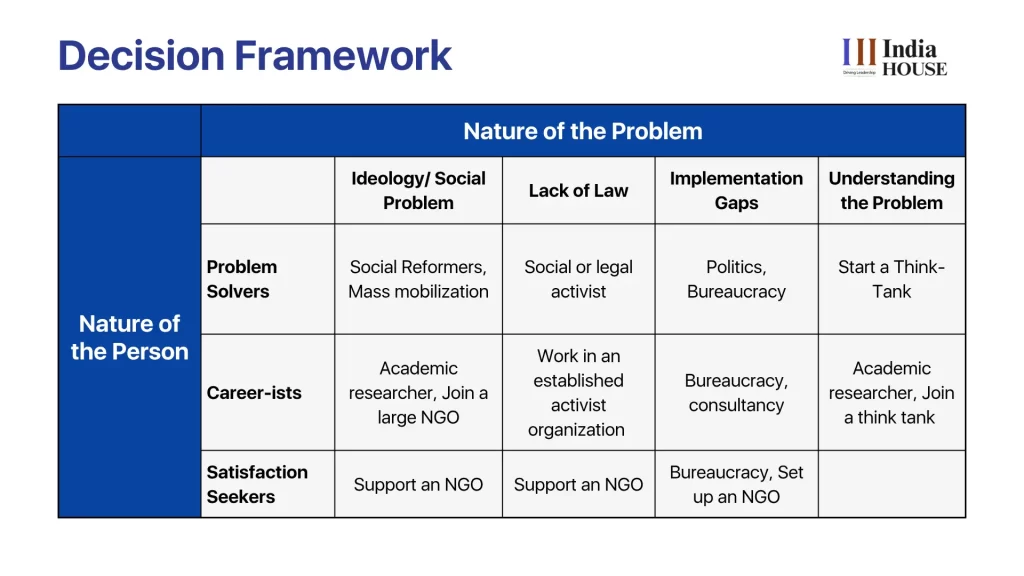
Our Methodology:
We mapped 60 different careers in public policy and clustered them into various categories. This framework helps you see your options from different perspectives, from who you are to what kind of work you may do.
The framework examines two key dimensions:
1. Who you are – your personality type, strengths, interests, and working style
2. The nature of the problem you want to solve – the specific challenges that excite you or matter to you
By combining these two dimensions, this framework reveals which career paths align best with your unique profile. Use this table as a guide to explore possibilities that match both your personality and your problem-solving interests.
Example: A Problem-Solver with a Passion for Social Issues
Let’s say your personality type is a problem solver. You enjoy analyzing challenges, finding solutions, and making processes better. Now, imagine your passion lies in social issues, you care about communities, equity, and creating real-world impact.
When you map these two together:
Personality + Passion → Problem-solving skills + Social impact = Social Reformer/ Social Mobiliser
This combination naturally points toward roles that might fit, where your analytical mindset meets your desire to drive change. You’ll be solving real-world social problems, organizing communities, and creating interventions that make a tangible difference in people’s lives.
Moving Forward
By now, you may have a clearer sense of where you could position yourself in the public policy careers ecosystem. This framework is meant to offer a starting point, not a final destination. Public policy careers are diverse, fluid, and full of opportunities to create meaningful impact across sectors and roles.
If you are looking for structured guidance to explore this space more deeply, public policy programs like the Policy Pioneers Program at India House can help you translate reflection into direction. Through mentorship, exposure to real policy questions, and practical learning, such policy leadership program allow you to test your interests before committing to a long-term path.
Clarity rarely arrives all at once. It develops through exploration, engagement, and informed choices. The important step is simply to begin.