The Making of a Policy Pioneer
Three Shaktis that can turn good intent into a good policy
On her first field visit, a young policy fellow opens her questionnaire under a neem tree in a village in Rajasthan. Five minutes in, an elderly woman puts a question to her that is not on any page:
“The scheme says I need this certificate. The office that issues it is two buses away, and it closes before the second bus arrives. Who wrote this rule? Have they ever taken that bus?”
The fellow has read the scheme document twice. She can recite its objectives. She has no answer.
That silence is where most policy failures begin. India does not lack good intentions or even good policies on paper. What often goes missing is the thread that connects the village under the neem tree to the room where the rule is drafted. So the question worth asking is this: what kind of person can hold that thread?
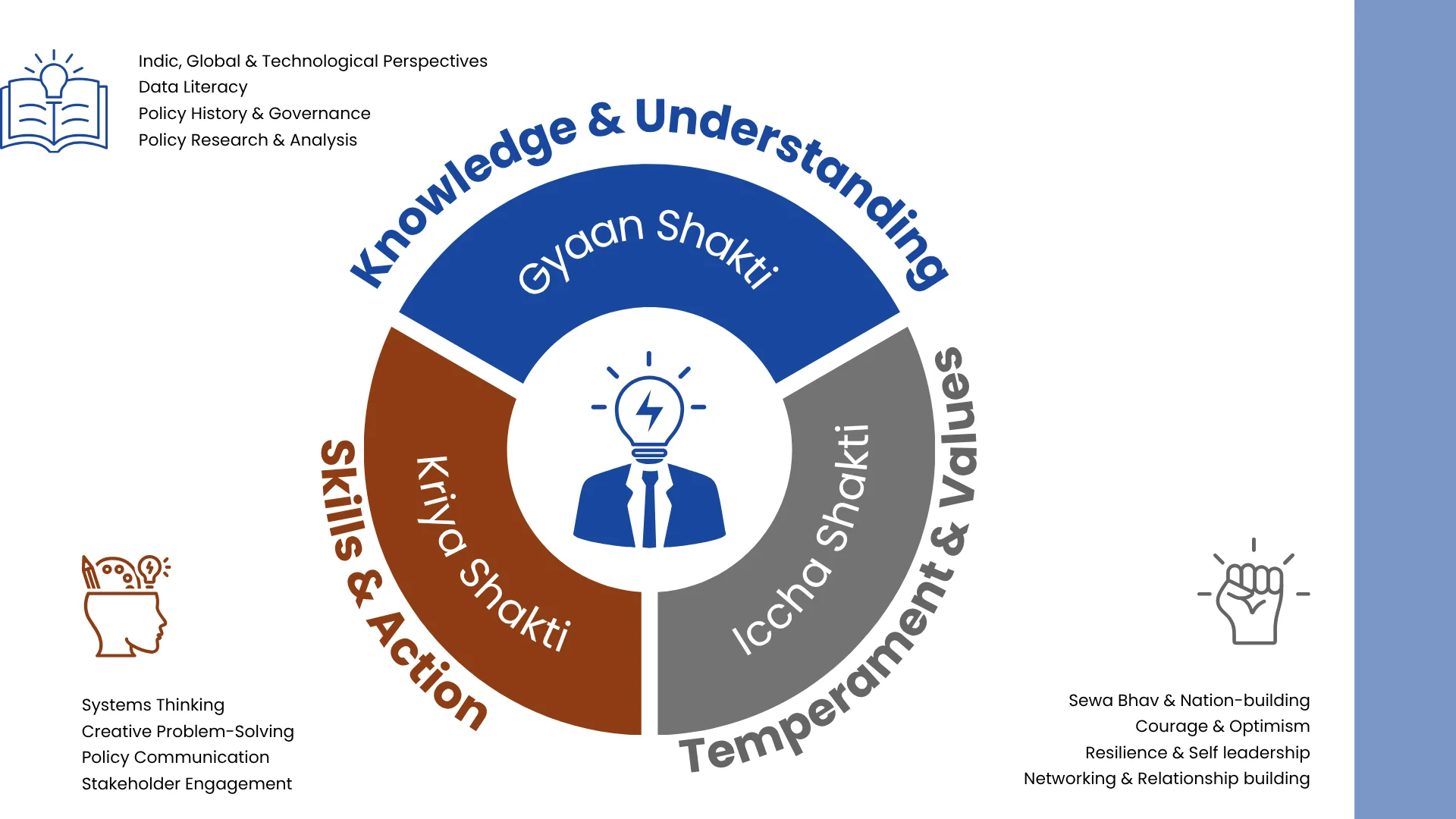
At India House, we have been thinking about exactly this, and we call such a person a policy pioneer. Our view is that a policy pioneer is built on three powers, borrowed from an old Indic way of understanding how any meaningful act comes to be: Ichha Shakti, Gyan Shakti and Kriya Shakti. Will, wisdom and action.
- Ichha Shakti
- Temperament and values
- Gyan Shakti
- Knowledge and understanding
- Kriya Shakti
- Skills and action
Ichha Shakti: the will to do something good
Every pioneer starts with a reason. Ichha Shakti is the intent to contribute, the quiet, stubborn wish to leave something better than you found it.
This is not the same as ambition. Ambition asks, “Where do I want to reach?” Intent asks, “What do I want to fix, and for whom?” The fellow under the neem tree did not need a better career plan in that moment. She needed to care about that woman’s bus journey enough to carry it back with her.
Intent is what keeps a pioneer going when the work is slow, the credit is scarce and the system pushes back. Without it, policy becomes paperwork. With it, even paperwork becomes a form of service.
In our framework, Ichha Shakti is about temperament and values: the inner orientation that sustains long-arc leadership. It shows up in four ways:
- Seva bhav and nation-building. A service orientation rooted in empathy and collective progress.
- Courage and optimism. Boldness in action, with a belief in positive change.
- Resilience and self-leadership. Discipline, perseverance and self-motivation.
- Networking and relationship-building. An inclination to connect, build trust and nurture alliances.
Gyan Shakti: the wisdom to see clearly
Good intent without understanding can do real damage. Gyan Shakti is the depth that turns a wish into a workable idea.
It is the intellectual foundation of a policy pioneer, that rests on understanding of:
- Policy history and governance. A grasp of past policies and institutional architecture: what has been tried before, what the law actually allows, and where schemes overlap or leave gaps.
- Indic, global and technological perspectives. Grounding in Indic thought, awareness of global trends and technological foresight. A pioneer who knows where a country has come from designs better for where it needs to go, rather than borrowing solutions built for somewhere else.
- Policy research and analysis. The ability to evaluate policy options critically, break a messy problem into parts, and tell a real cause from a convenient one.
- Data literacy. Using evidence effectively to make decisions.
Gyan Shakti is what lets the fellow, back in the city, trace that certificate rule to its source, understand why it was introduced, and see what could replace it or bring the services closer to the doors of the women.
Kriya Shakti: the skill to carry it across
This is the power that is easiest to overlook, and the one that decides whether an idea ever leaves the notebook.
Kriya Shakti is the ability to communicate and act: to put your point forward clearly, to listen so that the other person feels heard, and above all to translate. A pioneer must take what she heard under the neem tree and say it in the language of policy, with the clarity, evidence and framing that a joint secretary, a minister or a funder can act on. And she must be able to do the reverse as well, explaining a policy to the people it affects in words they can use.
A field story told as a lament changes nothing. The same story, backed by data, framed as a specific design flaw and paired with a feasible fix, can change a rule. That is Kriya Shakti: ground reality turned into policy language, and policy language turned back into ground reality.
Kriya Shakti rests on skills and action: the applied abilities to act with clarity and competence. Some of these abilities are:
- Systems thinking. Seeing interconnections and long-term impacts.
- Creative problem-solving. Applying lateral and innovative approaches.
- Policy communication. Expressing ideas clearly to diverse audiences.
- Stakeholder engagement. Building coalitions and enabling collaboration.
Why you need all three
Take any one away and the pioneer falls short.
- Intent without wisdom produces well-meaning schemes that fail on contact with reality.
- Wisdom without intent produces brilliant reports that nobody acts on, including their authors.
- Intent and wisdom without communication produces the best-kept secret in the room: the right idea that never reaches the right ear.
Policy pioneers are the rare people in whom all three meet. They care, they understand, and they can make others understand too.
The good news: these powers can be grown
None of the three is a birthright. Intent deepens when you spend time with the people your work is meant to serve. Wisdom grows with reading, questioning and learning from those who came before. Communication sharpens with practice, writing and rewriting, speaking to audiences who disagree with you, and asking whether you were understood rather than whether you sounded impressive.
That is the idea behind the pioneer’s journey: a path from the ground to the gazette, from the neem tree to the notification, walked with all three powers in hand.
A question to carry with you
The next time you come across a rule that seems puzzling or unfair, pause before you shrug it off. Ask who it was written for, who it leaves out, and what it would take to change it.
Then ask the harder question:
The woman under the neem tree is still waiting for an answer. Perhaps it will come from you.