
You have probably heard a government scheme praised for changing lives. You have probably also seen one criticised, quietly wound down, or replaced. And you may have wondered why a scheme that works in one district barely registers in the next.
The same questions come up closer to home. Your local government school may have new classrooms, but are there enough teachers to fill them?
So how do we know whether a policy is working? And when it falls short, how do we find out why?
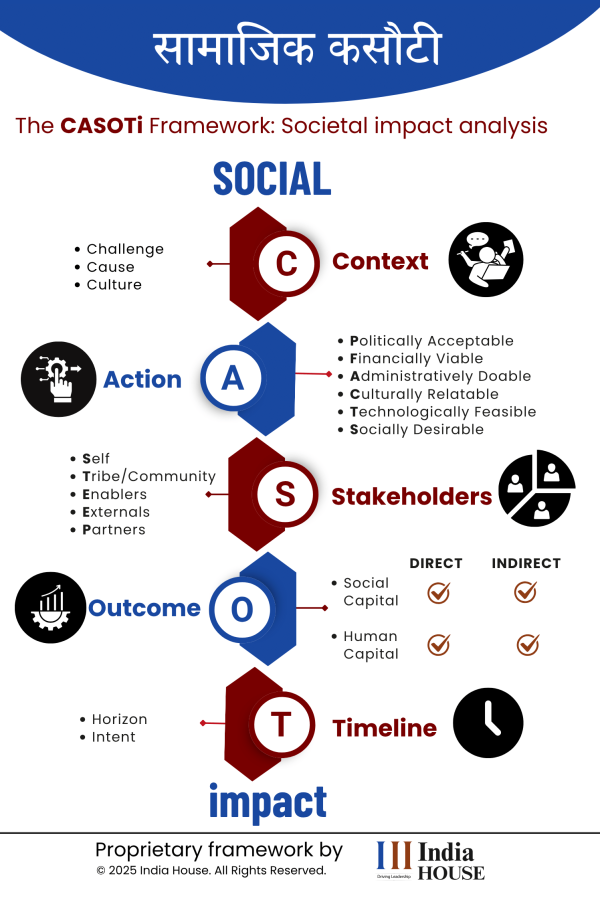
Answering that means looking at the circumstances, the choices made, the people involved and the changes that follow. India House’s CASOTi framework for societal impact analysis helps organise that inquiry through five connected lenses: Context, Action, Stakeholders, Outcome and Timeline.
The lenses make most sense when you follow a single scheme through all five. So we will stay with one for the rest of this piece: Swachh Bharat Mission-Grameen, India’s rural sanitation program.
Context: find the problem behind the problem
Context asks what the challenge is, what causes it and what the culture around it looks like.
It comes first because every policy rests on a theory of the problem, and when that theory is wrong, everything built on top of it inherits the error.
Swachh Bharat Mission-Grameen was launched in 2014 to end open defecation in rural India, and by October 2019 the government reported more than 10 crore household toilets built and every village declared open-defecation-free. (Source: Department of Drinking Water and Sanitation.) That is a serious achievement, though it answers a question about supply, which was one reading of the problem among several.
Picture two villages with the same gap in toilet access. In the first, families want toilets and cannot afford them; in the second, toilets exist but sit unused because water is scarce or the pit has filled up. A construction subsidy would transform the first village and change almost nothing in the second.
This matters because a solution aimed at the wrong obstacle can absorb years of budget and goodwill while the problem stays exactly where it was.
Action: can it work in real life?
Action asks whether the chosen response survives contact with reality, testing it on six counts from political acceptability to technological feasibility. Policies are designed in offices and lived in households, and most good intentions are lost somewhere between the two.
For a toilet, those conditions are specific. Is there water to flush it, will the design hold through the monsoon, and when the pit fills, who empties it?
The government’s own verification survey shows how much rides on those answers. The National Annual Rural Sanitation Survey found 85% of the rural population using safe, functional and hygienic toilets in 2019-20, up from 62.3% two rounds earlier. (Source: NARSS Round-3, 2019-20, carried out by an independent agency for the Department of Drinking Water and Sanitation.) That is real progress, and it also shows that people covered by a toilet and people using a working one are two different counts.
This matters because a scheme measured by what it installs will always look stronger than the same scheme measured by what still functions.
Stakeholders: who makes the change happen
Stakeholders asks who actually has to act, sorting them into five groups from the household itself to the partners around it. A document does not implement a policy; people do, and a design that assumes cooperation without naming who does what is a design with a hole in it.
A family may want to use the toilet, but masons, panchayat officials, sanitation workers and self-help groups all shape whether it still works in year three. So the analysis goes past listing beneficiaries to ask who holds responsibility, who bears the cost and whose concerns nobody has raised. Where a village shares a toilet and no one has agreed who cleans it or pays for repairs, the structure can be sound while the arrangement around it quietly collapses.
This matters because policies rarely fail on the day they are delivered. They fail months later, in the gap between what people were assumed to do and what anyone actually agreed to.
Outcome: what changed, and for whom
Outcome asks what actually changed, tracking human capital, meaning health, knowledge and skills, and social capital, meaning trust and the ability to act together. This is the lens that separates activity from achievement.
Counting toilets tells us what was delivered, while regular use, child health and the safety and dignity of women and girls tell us what changed.
Who changed matters just as much. Behind that national figure of 85%, the same survey put Kerala at 99.5% and Bihar at 47.4%, and a single average holds both.
This matters because an average is a summary rather than a verdict, and a policy can lift the national picture while leaving the households that needed it most roughly where they started.
A family may want to use the toilet, but masons, panchayat officials, sanitation workers and self-help groups all shape whether it still works in year three. So the analysis goes past listing beneficiaries to ask who holds responsibility, who bears the cost and whose concerns nobody has raised. Where a village shares a toilet and no one has agreed who cleans it or pays for repairs, the structure can be sound while the arrangement around it quietly collapses.
This matters because policies rarely fail on the day they are delivered. They fail months later, in the gap between what people were assumed to do and what anyone actually agreed to.
Timeline: how long before we judge?
Timeline asks over what period we expect change and what kind we are after, whether quick relief, a lasting shift in behaviour or a stronger institution. Without it, assessment collapses into an argument between people declaring victory too early and people declaring failure too early.
Building a toilet takes weeks, changing a daily habit takes years, and sustaining both takes an institution that keeps working after the targets are met, which is why the mission’s second phase shifted towards holding on to open-defecation-free status and managing waste.
A long horizon cannot become an excuse to stop checking. Are toilets still functional after three years, are pits emptied safely, is usage holding steady?
This matters because naming a horizon also means naming the checkpoints along it, and a policy without checkpoints can drift for a decade before anyone notices.
Counting toilets tells us what was delivered, while regular use, child health and the safety and dignity of women and girls tell us what changed.
Who changed matters just as much. Behind that national figure of 85%, the same survey put Kerala at 99.5% and Bihar at 47.4%, and a single average holds both.
This matters because an average is a summary rather than a verdict, and a policy can lift the national picture while leaving the households that needed it most roughly where they started.
A family may want to use the toilet, but masons, panchayat officials, sanitation workers and self-help groups all shape whether it still works in year three. So the analysis goes past listing beneficiaries to ask who holds responsibility, who bears the cost and whose concerns nobody has raised. Where a village shares a toilet and no one has agreed who cleans it or pays for repairs, the structure can be sound while the arrangement around it quietly collapses.
This matters because policies rarely fail on the day they are delivered. They fail months later, in the gap between what people were assumed to do and what anyone actually agreed to.
Putting the lenses together
The five lenses assess impact, diagnose underperformance and test a proposal before launch. They also point at each other: low usage sends you back to context, a maintenance failure reveals unclear responsibilities, and a missed milestone exposes an unrealistic timeline.
So the next time you read that a scheme has hit its target, pause and ask what was delivered, what changed, for whom, and whether it will last.
Learn to think this way
Frameworks like CASOTi are how analysts move from opinion to evidence, and they sit at the heart of serious work on public policy in India. If you want to build these public policy skills, India House runs Policy Pioneers, a public policy leadership program for people who want to understand how governance actually works. It is built for students and early professionals exploring public policy careers.
So the next time you read that a scheme has hit its target, pause and ask what was delivered, what changed, for whom, and whether it will last.
Tagscareers, Problem Solving, public policy, Stages in policy, stakeholder management
CategoriesBlog
DateSep 24, 2026